Ask a coffee snob about Robusta and you will usually get a shrug. It is the "cheap" bean, the one that goes into instant coffee and blends, the poor cousin of Arabica. Then you drive into Wayanad, where almost every farm grows it, and you start to wonder how a whole district ended up betting on the bean nobody brags about.
The answer involves a smuggler’s legend, a British army garrison, a boom that made fortunes, and a fungus that wiped most of it out. The video below tells the story in under four minutes. The longer version follows.
The legend: seven beans
India’s coffee story usually starts with Baba Budan, a Sufi saint said to have returned from pilgrimage to Mecca in the 1600s with seven coffee beans hidden on him. Exporting fertile beans from Yemen was forbidden at the time, so the story goes that he smuggled them out and planted them in the hills of Chikmagalur, in what is now Karnataka. Those hills still carry his name.
Nobody can prove the details. Seven is a suspiciously tidy number. But coffee did take root in those southern hills, and over the next two centuries it crept along the Western Ghats.
From the coast to the hills
Wayanad’s own chapter begins down on the coast. Around 1800, the East India Company ran an experimental spice estate at Anjarakandy, near Thalassery, managed by a Scot named Murdoch Brown. Coffee was one of the crops he tried, and it did well enough that people noticed.
In 1825, a Captain Bevan took charge of the garrison at Mananthavady, then written as "Manantoddy", up in the hills. He brought coffee plants up from Anjarakandy and planted them around the camp. They grew so well that seed was handed out to local cultivators. A few years later, two men from the Madras firm Parry and Company passed through, liked what they saw, and backed a new estate on the hill. It was the beginning of a rush.

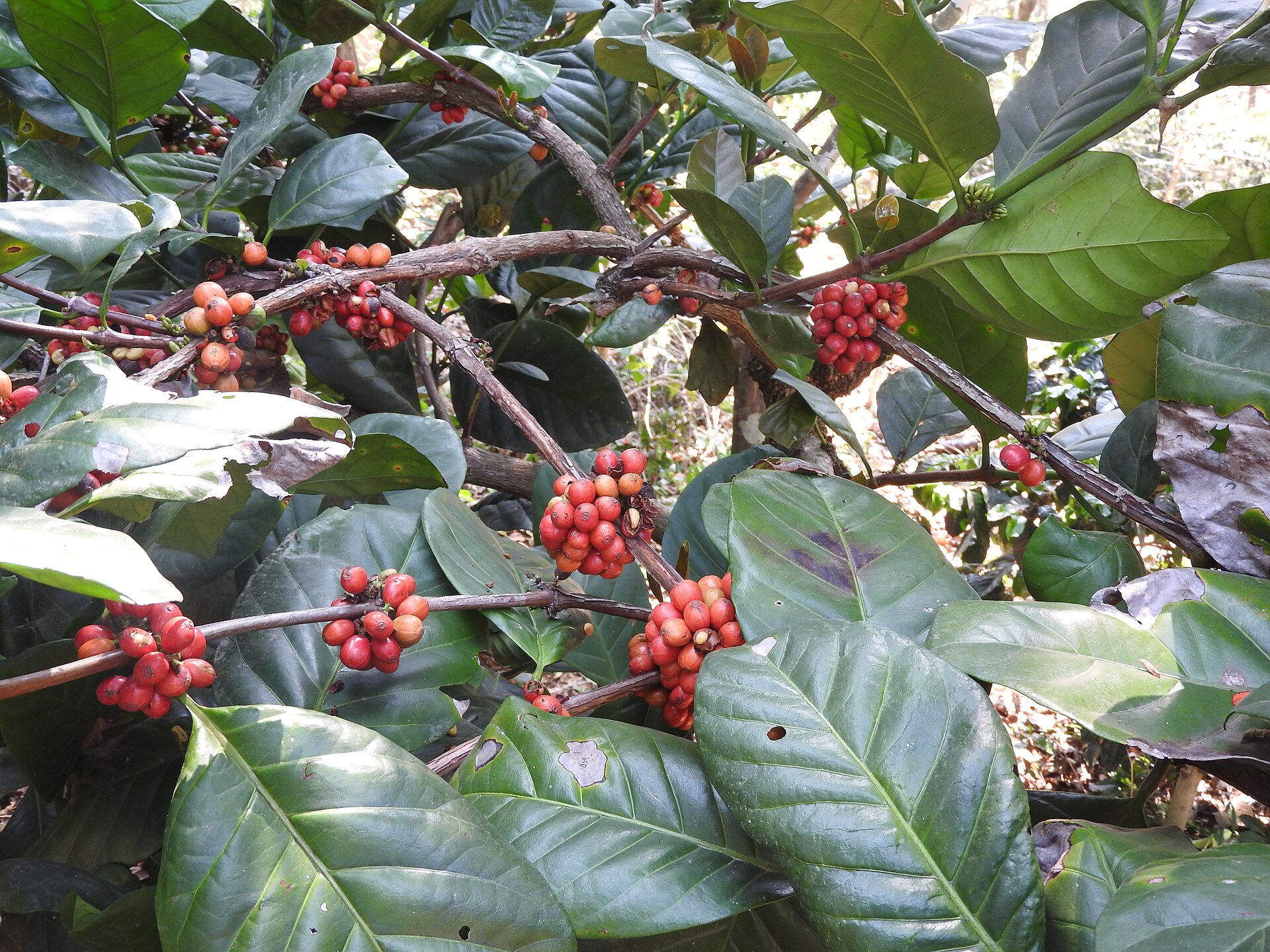
Photo: Yercaud-elango via Wikimedia Commons, CC BY-SA 4.0
The boom
By the 1860s, Wayanad had a couple of hundred coffee estates. Most were owned by Europeans, and the rest by traders and investors from the coast. Estates spread across Mananthavady, Panamaram, Vythiri, Sulthan Bathery and further south. Forest came down, roads went up, and workers arrived from the plains to clear and pick. Almost all of it was Arabica, the prized bean.
The fungus
Then came the fungus. In 1869, planters in Ceylon, today’s Sri Lanka, noticed orange, powdery spots on the underside of coffee leaves. It was coffee leaf rust, a fungus called Hemileia vastatrix. Infected leaves fall early, the plant weakens, and the crop collapses. Ceylon was the biggest coffee grower in the region, and within a couple of decades its coffee industry was largely gone. The island switched to tea.

Photo: Smartse via Wikimedia Commons, CC BY-SA 3.0
The rust reached the estates of south India too. Across Wayanad, Arabica plantings failed season after season. Some planters gave up. Others replaced coffee with tea, which is why the higher, cooler parts of the district are still covered in tea gardens today.
Robusta takes over
The planters who stayed with coffee needed a tougher plant, and Robusta was the answer. It is a different species, Coffea canephora. It stands up better to the rust, it is happy at lower elevations and in heavy rain, and it yields more. The beans carry more caffeine and a harsher, earthier taste, which is why Robusta sells for less. But in Wayanad’s conditions it survives and produces, and in farming that counts for more than reputation.
Over time Robusta became Wayanad’s crop. Today it makes up well over 90 per cent of the coffee grown in the district, and Wayanad produces most of Kerala’s coffee. In 2019 "Wayanad Robusta" received a Geographical Indication tag, which recognises the coffee as specific to this place. Much of it goes into espresso blends, where Robusta’s body and crema are an asset rather than a flaw.
Wayanad coffee today
The big colonial estates are mostly gone. Wayanad coffee today is grown largely by small farmers, many of them working a few acres. The Coffee Board of India supports research and prices, but day to day, this is family farming.
What makes it worth seeing is how the farms look. Walk onto one and it feels more like a forest than a plantation. Tall shade trees such as silver oak and jackfruit stand over the coffee bushes. Black pepper vines climb the tree trunks. There might be areca palms, banana and cardamom in between. One small plot is doing several jobs at once, and the shade keeps the soil and the birds alive.
When to see it
- Harvest, roughly December to March: this is when red cherries are picked by hand and spread out to dry in front yards and on rooftops across the district. The smell of drying coffee follows you down every village road.
- Blossom, usually around March: after the first summer showers, the bushes burst into white flowers all at once. The scent is closer to jasmine than coffee, and it lasts only a few days, so timing matters.

Photo: Timothy A. Gonsalves. Feel free to use my photos, but please mention me as the author. I would much appreciate if you send me an email tagooty@yahoo.com or write on my talk page, for my information. Please contact me before commercial use. Please do not upload an edited image here without consulting me. I would like to make corrections only at my own source to ensure that the changes improve the image and are preserved.Otherwise you may upload an edited image with a new name. Please use one of the templates derivative or extract. via Wikimedia Commons, CC BY-SA 4.0
Several farm stays and homestays in Wayanad let you walk the plots and see the drying and roasting. Ask around in Kalpetta or Sulthan Bathery rather than booking a packaged "coffee tour"; a farmer who grows it will tell you more in an hour than any brochure.
The long way behind your cup
Next time you drink a blend with a strong, bitter backbone, there is a fair chance some of it grew under a jackfruit tree in Wayanad. It got there through a smuggled seed, a soldier’s garden, a speculative boom and a fungus that forced everyone to start again.

Photo: Yercaud-elango via Wikimedia Commons, CC BY-SA 4.0
If you are planning a trip, our guide to Wayanad’s history trail pairs well with a farm visit, and ten things to know before you visit Wayanad covers the practical side.