Picture this. You land in a new place. You have five days. So you make a list. Day one, see the famous lake. Day two, ride a boat. Day three, drive to the hills. Day four, visit a tea farm. Day five, rush to the beach before your flight. You take a thousand photos. You check off every box. And then you go home so tired that you need a holiday to recover from your holiday.
Many of us travel this way. We treat a trip like a race. We try to see everything, and in the rush we end up really seeing nothing. We pass through a place instead of being in it.
Slow travel is the opposite of that race. It is a calmer, kinder way to explore a place. And once you try it, regular travel starts to feel a little silly. In this post, we will look at what slow travel really means, where the idea came from, and why Kerala may be one of the best places on Earth to do it.
So What Is Slow Travel, Really?
Slow travel is simple to explain. It means three things: stay longer, move less, and pay more attention.
That is the whole idea. Instead of jumping between five towns in a week, you pick one or two and really get to know them. Instead of flying or driving everywhere as fast as you can, you take the slow boat or the local train and let the journey be part of the fun. Instead of ticking off famous sights, you sit in a small café long enough to have a favorite table.
Here is one way to think about it. Fast travel asks, “How many places can I see?” Slow travel asks, “How well can I know this one place?” One is about quantity. The other is about quality.
And here is the part that surprises people most. Slow travel is not about how much time you have. You do not need three months off work. You do not need to be rich or retired. You can travel slowly on a two-week trip, or even a long weekend. The trick is not the length of the trip. The trick is your pace and your mindset. A backpacker who spends a month in one city is traveling slowly. A couple who spends three quiet weeks in one hotel is traveling slowly too. What matters is depth, not your budget or your bag.
Slow travel goes by a few other names, like mindful travel, gentle travel, or low-impact travel. They all point at the same thing. Slow down. Look closer. Care more.
Where Did This Idea Come From?
The story of slow travel starts with food, not travel. And it starts in Italy.
Back in the 1980s, a fast-food restaurant was set to open near a famous square in Rome. A writer named Carlo Petrini was not happy about it. He worried that fast food would push out local cooks, local farmers, and old family recipes. He worried that people were starting to eat in a rushed, careless way, and that something important was being lost.
So he started a movement and called it Slow Food. The idea was that how you eat matters just as much as what you eat. A meal made with care, from local ingredients, eaten slowly with people you love, is a different thing from a burger eaten alone in a hurry. Slow Food said: protect the good, careful, local way of doing things.
That simple idea spread. People started to ask, “If we can slow down our food, why not slow down other parts of life too?” Soon there was slow living, slow design, even slow cities. In 2004, a writer named Carl Honoré wrote a book called In Praise of Slow that pulled all these ideas together. He described the slow movement as a quiet revolt against the belief that faster is always better.
Travel was a natural next step. If rushing your meals makes them worse, maybe rushing your trips makes them worse too. And so the idea of slow travel was born. It is really just the Slow Food spirit applied to the way we explore the world.
The Simple Rules of Slow Travel
There is no rulebook you must follow. But over the years, slow travelers have settled on a handful of shared ideas. Think of these as gentle guides, not strict laws.
Pick fewer places and stay longer
This is the big one. If you would normally cram four towns into two weeks, do two instead. Give each place enough time to surprise you. Most slow travelers find that a week in one spot is when the magic really starts. That is about how long it takes to stop feeling like a visitor and start feeling like you almost live there. You learn the shortcut to the market. You start to recognize faces. The place stops being a postcard and becomes real.
Let the journey be part of the trip
Fast travel treats the journey as a problem to solve. Get from A to B as quickly as you can. Slow travel flips this around. The train ride, the ferry, the slow bus through the hills, these are not just ways to get somewhere. They are part of the trip itself. When you take the slow boat, you see how the land changes. You smell the air. You watch ordinary life roll past your window. Sometimes the journey becomes the best memory of all.
Live like a local, even for a little while
Slow travelers love to step into daily life. They shop at the morning market. They eat where the locals eat. They stay in a family home or a small guesthouse instead of a big hotel. They learn a few words of the local language, even if they get them wrong. The goal is not to watch a place from behind glass. The goal is to take part in it, gently and with respect.
Spend your money close to the ground
When you eat at a small family restaurant, your money goes straight to that family. When you stay in a homestay, you support the people who live there. Slow travel tries to keep money in the hands of local people, not big companies far away. It is a small choice that makes a real difference.
Skip the crowds when you can
Some places are so popular that they buckle under the weight of all the visitors. Slow travelers try to take the pressure off. They pick quieter spots, travel in the off-season, or visit the less famous village down the road. Often these quieter places turn out to be the best part of the whole trip.
Drop the to-do list
This one is hard for many of us. We love a plan. But slow travel asks you to leave gaps in your day. Leave room for the unplanned chat with a shopkeeper, the side street you wander down, the long lazy lunch that turns into the afternoon. Some of the best travel moments cannot be planned. They can only be allowed.
Why Bother? The Quiet Gifts of Slowing Down
Maybe you are thinking, “This sounds nice, but what do I actually get out of it?” Fair question. It turns out slow travel gives you quite a lot.
You come home rested, not wrecked. Rushing from sight to sight is exhausting. Many people return from fast trips more tired than when they left. Slow travel lets you actually relax. You sleep in. You sit by the water. You breathe. The trip becomes a real break instead of a second job.
You remember more. Be honest. A year from now, you will not remember standing in line for a famous photo spot. But you will remember the old man who taught you how to crack a coconut, or the meal cooked by your host, or the morning the fog lifted off the hills. Slow travel is full of these small, sticky memories. They are the ones that last.
It can be kinder to your wallet. When you stay in one place longer, you often pay less per night. You cook some meals or eat simple local food. You spend less on flights and long drives. Slow does not always mean cheap, but it often costs less than the rush.
It is gentler on the planet. Fewer flights and fewer long car rides mean a smaller carbon footprint. Trains, boats, bikes, and your own two feet are far easier on the Earth. If you care about the places you visit, traveling slowly is one way to show it.
You actually meet people. When you slow down, you have time for real conversations. You meet families, not just front-desk staff. You make a friend, not just a booking. Talk to almost any slow traveler, and they will tell you the same thing. The best part of any place is usually the people.
Why Kerala Is Practically Made for Slow Travel
Now we get to the heart of it. Some places fight against slow travel. They are loud, fast, and built for the rush. Kerala is the opposite. This green strip of land along India’s southwest coast feels like it was designed for slowing down. Let us look at why.
The land itself moves slowly
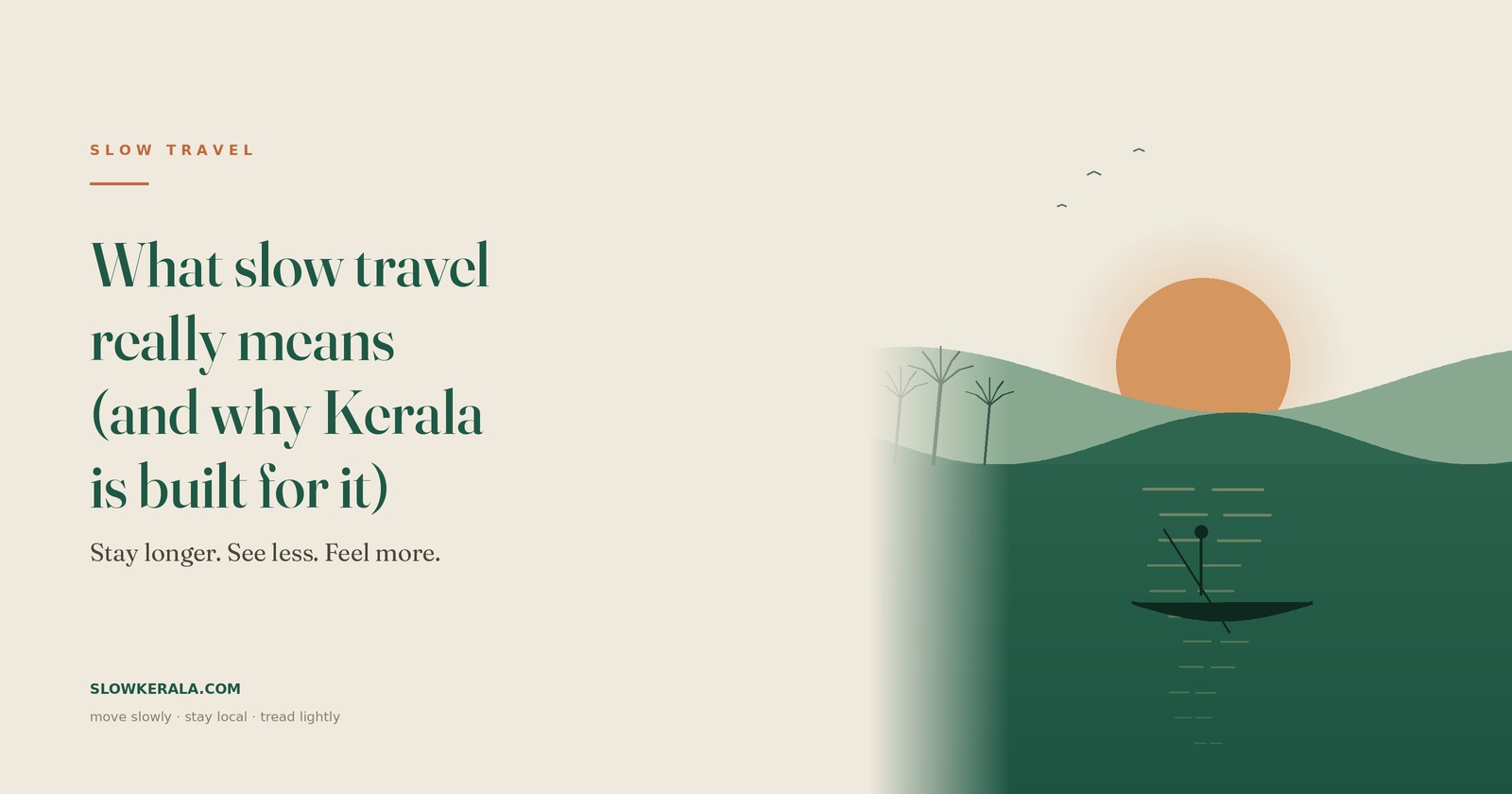
Kerala’s most famous feature is its backwaters. These are a huge network of calm canals, rivers, and lakes that stretch for hundreds of kilometers along the coast. Life here has always moved at the speed of a boat. Children paddle to school in narrow canoes. Women wash pots at the water’s edge. Fishermen drift out at dawn. You cannot rush in a place like this, and you would not want to. The water sets the pace, and the pace is slow.
Beyond the backwaters, the land keeps inviting you to take your time. There are misty tea hills in places like Munnar, where the air is cool, and the green goes on forever. There are spice farms tucked into the Western Ghats mountains. There are quiet beaches and fishing villages along the coast. None of it rewards rushing. All of it rewards lingering.
The homestay was practically born here
Here is something many travelers do not know. The homestay, where you stay in a local family’s home instead of a hotel, has deep roots in Kerala. The state has welcomed visitors into family homes for a long time, and it remains one of the best places in the world to try it.
In a Kerala homestay, you do not just sleep. You eat meals cooked from the family’s own garden. You learn how the backwaters change with the seasons. You might join in a bit of fishing, or watch coir rope being made by hand, or take a cooking lesson in a real kitchen. Travelers who try it often say the homestay was the best part of their whole trip. It is human warmth in its purest form, and no fancy hotel can copy it.
The food is local, fresh, and worth slowing down for
Remember, slow travel grew out of slow food. So a place with deep, local food traditions is a natural fit. Kerala delivers. The cooking here leans on coconut, rice, fresh fish, and spices grown right in the hills. The grand feast called the sadya, served on a banana leaf, is meant to be eaten slowly and with your hands. Food in Kerala is not fuel you grab on the run. It is an event. It asks you to sit, to share, and to take your time.
You can get around without a car
One of the joys of slow travel is using local transport, and Kerala makes this easy. There are public ferries that lock you into the rhythm of the water. There are trains that roll past paddy fields and palm groves. There are local buses that take you into villages that rarely see a tourist. You can cycle through the rice fields or walk between hill villages. You do not need to hire a private car and a driver to see Kerala. You can move the way locals move, and the journey becomes half the pleasure.
The state actually believes in this stuff
Here is the part that ties it all together. Kerala has spent decades building up what it calls responsible tourism. The idea is simple. Tourism should help local people, not push them aside. So the state has helped farmers open spice-farm visits, helped families turn their homes into homestays, and helped women earn a living through cooking, crafts, and hosting. Tourism is a big part of Kerala’s economy, and a real effort has been made to spread those benefits to ordinary villages.
For a slow traveler, this is wonderful news. It means that when you travel slowly and spend close to the ground, the whole system is set up to send your money to the right places. You are not fighting against the grain. You are going with it.
Even the pace of life is gentle
Travelers often describe Kerala as an easy place to be. The pace of daily life is calm. The people are warm and welcoming. Many call it a gentle first taste of India, softer and slower than the big northern cities. When the place around you is already relaxed, slowing down is not something you have to work at. It just happens.
A Word of Care: Slow Travel as Respect
There is one more reason slow travel matters in Kerala, and it is an important one.
The backwaters are beautiful, but they are also fragile. They are a living system that feeds fish, waters rice fields, and supports whole communities. When tourism grows too fast and too carelessly, it can hurt these places. Too many big diesel houseboats can foul the water. Plastic trash can pile up. Big resorts can crowd out the families who have always lived there.
Slow travel is a quiet answer to this problem. When you choose a small boat over a big one, a homestay over a giant resort, and local food over packaged snacks, you tread more lightly. You leave the place as lovely as you found it, or even a little better. In Kerala, traveling slowly is not just nicer for you. It is a way of caring for the place and the people who call it home.
That is what the very best travel comes down to in the end. Not how much you saw, but how well you treated the place that welcomed you.
How to Start, Even on Your Next Short Trip
You do not need to quit your job and vanish for a year. You can begin slow travel on your very next trip, even a short one. Here are a few easy ways to start.
- Cut your list in half. Whatever number of places you planned to visit, try doing half of them with twice the time.
- Stay in one base. Pick one good spot and take day trips from there instead of packing and moving every two days.
- Choose a family home. Book a homestay or a small guesthouse instead of a big hotel, at least for a few nights.
- Take the slow way. Swap one car ride or flight for a train, a ferry, or a long walk.
- Eat where locals eat. Find the small, busy place full of local families. Skip the fancy spot with the great view and the so-so food.
- Leave a gap. Keep one afternoon with nothing planned and see what finds you.
That is it. Do a few of these, and you are already a slow traveler. The mindset grows from there.
The Bottom Line
Slow travel is not about being lazy, and it is not only for people with endless time and money. It is a choice to swap rushing for richness. To trade a long list of sights for a handful of real memories. To stop passing through places and start truly being in them.
The idea began with a plate of food in Italy and the simple belief that care beats speed. That belief turned out to fit travel perfectly. And of all the places in the world to put it into practice, few are as ready as Kerala. The slow waters, the family homes, the local food, the gentle pace, and the deep respect for the land all point in the same direction. Slow down. Look closer. Care more.
Kerala has been waiting, calm and green and unhurried, for travelers ready to do exactly that. The only question is whether you are ready to slow down and meet it. We think you are.