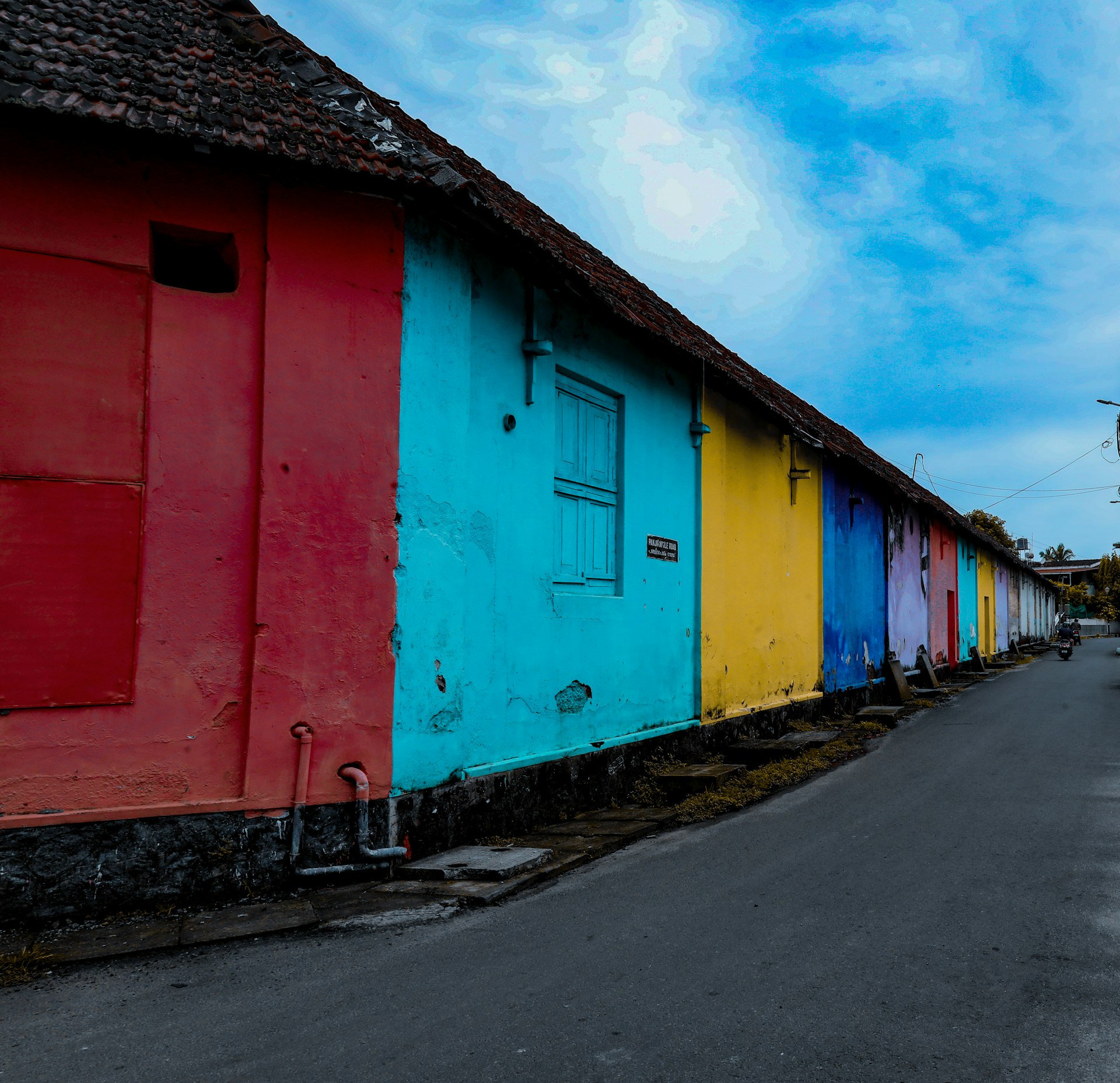
Kerala’s coast is where its long history washed up. For two thousand years, traders came here for pepper and spice, and left behind churches, mosques, a synagogue, forts, warehouses, and a way of living that mixes the whole Indian Ocean into one green strip of land. The beaches are lovely, but the old towns are the real treasure, and both reward a slow traveller who stays put.
Most visitors give the coast a night or two on the way to somewhere else. I want to make the case for basing yourself here properly. This is the parent guide for the coast and town place guides to come. Read it with how to plan a slow Kerala trip yourself as you shape your route.
Fort Kochi and Mattancherry: the perfect slow base
If I could send you to just one place on the coast to stay a while, it would be Fort Kochi, with its neighbour Mattancherry. Together they make one of the best slow bases in all of Kerala.
Here, in a walkable few square kilometres, centuries sit side by side: the old Chinese fishing nets dipping into the harbour at sunset, Portuguese and Dutch colonial streets, St Francis Church, the Paradesi Synagogue and Jew Town’s antique lanes, spice warehouses that still smell of ginger and turmeric, and the palace museum in Mattancherry. It is a place made for wandering on foot, with cafes, small galleries, and street art tucked into old buildings.
Why it is such a good slow base:
- You can walk everywhere. No car needed; the whole area is a stroll.
- It is close to the airport, so it makes a gentle first or last stop.
- It rewards repetition. Stay four or five nights and you will find a favourite tea shop, a favourite corner, a rhythm.
- It connects easily to the backwaters south and the hills east, by train and bus, as covered in getting around Kerala without a driver.
Cross the harbour to mainland Ernakulam on the little public ferry for the everyday, non-touristy side of Kochi: markets, cinemas, and real city life. That ferry ride, breezy and cheap, is a pleasure in itself.
From the field
The Chinese fishing nets at sunset are on every Kochi postcard, and they are genuinely lovely, but the crowd all faces the same way at the same hour. My tip: come back the next morning, early, when the fishermen are actually working the nets and there is almost no one there. Buy the catch if you like, and take it to one of the little stalls that will cook it for you. That quiet morning is the real Fort Kochi.
Varkala vs Kovalam, honestly
Down south are Kerala’s two famous beach towns. Which one to choose is a common question, so here is an honest look at both.
Varkala: cliffs, character, slower
Varkala is set along a dramatic cliff above the beach, with a path of cafes, shops, and guesthouses running along the top and the sea below. It has a laid-back, slightly bohemian feel, a sacred beach with real cultural meaning (Papanasam), and a character that Kovalam has partly lost. For a slow traveller, Varkala is the better pick: it is more relaxed, more atmospheric, and better for long, do-nothing days.
Kovalam: convenient, developed, busier
Kovalam, closer to Trivandrum, is Kerala’s oldest beach resort and the more built-up of the two, with a famous lighthouse beach and plenty of hotels. It is convenient and has good facilities, but it is busier and more commercial, and it lost some of its charm to development years ago. It suits travellers who want easy beach access near the airport and do not mind the crowds.
My honest steer: for slow travel, choose Varkala unless convenience to Trivandrum airport is your priority. And remember that both are best outside the rough-sea monsoon months; see when to visit Kerala.
| Place | Feel | Best for | Watch out for |
|---|---|---|---|
| Varkala | Cliffs, laid-back, characterful | Slow beach days, atmosphere | Cliff-path can be touristy in peak season |
| Kovalam | Developed, convenient | Easy beach near Trivandrum | Busier, more commercial |
The case for north Malabar
Here is where I get a little evangelical. Most visitors never go north of Kochi, and in doing so they miss what may be the most rewarding slow Kerala of all: north Malabar, the districts of Kannur, Kasaragod, and around.
The north is quieter, less touristy, greener, and in many ways more itself. Here is what is waiting:
Kannur and Thalassery
Kannur offers long, often near-empty beaches, a working coastline, and handloom and beedi history, plus it is a gateway to the Theyyam ritual season (roughly December to March), one of the most extraordinary living art forms in India, performed through the night in village shrines. Watch it quietly and respectfully; it is worship, not a show.
Nearby Thalassery (Tellicherry) is a food and history lover’s dream: an old fort, cricket history, and above all Malabar cuisine at its source, the home of the famous Thalassery biryani and a whole world of Muslim-Malabar cooking and snacks. Eat your way through it with eating in Kerala as your guide.
Bekal and the far north
Up near Kasaragod, Bekal has a big, photogenic seaside fort and quiet beaches, and the far north blends Kerala with the neighbouring Tulu and Kannada cultures into something distinct. It is about as far from the tourist trail as Kerala gets while still being easy to reach by train.
Why go north:
- Fewer crowds, lower prices, warmer welcomes, because you are off the standard circuit.
- Theyyam, if your timing is right, which is reason enough on its own.
- The food, especially Malabar Muslim cooking, at its absolute source.
- Real, unpolished coast and town life, the slow Kerala that packages skip.
The catch is simply distance and a little less tourist infrastructure, which is exactly why it stays special. Give it three or four nights on a longer trip and it may become your favourite part. [VERIFY: current best Theyyam-viewing approach for respectful visitors, e.g. asking locally, which shrines welcome visitors, and season dates for the coming year.]
A slow coast day
To set the pace, an unhurried day based in an old coastal town:
- Early. A walk to the water before the heat, watching the fishing boats or the nets at work.
- Morning. Wander the old streets, a church or synagogue or fort, a market, a long coffee.
- Midday. A proper local lunch, fish and rice on the coast, biryani in Malabar, then the hot hours in the shade.
- Afternoon. A short ferry or a stroll to a neighbouring quarter, or simply the beach.
- Evening. Sunset on the water, dinner from the local kitchen, and, if you are lucky and it is the season, the far-off drums of a Theyyam.
Pair a coastal base with time on the backwaters and up in the hills, and you will have travelled the whole breadth of Kerala without ever hurrying. The coast holds the state’s memory. Stay long enough for it to tell you some of it.
Day trips from a coastal base
One of the joys of settling into a coastal town is that you can reach a surprising amount without moving your bags. From Fort Kochi, easy day trips include the everyday markets and museums of mainland Ernakulam by ferry, the backwater fringes just south, and the historic town of Thrissur further north by train. From a Varkala base, the temple town of Varkala itself, the backwaters around nearby Kollam, and quiet fishing villages down the coast are all within reach.
The slow rule still applies: do not try to day-trip somewhere every single day. Pick one or two outings across a four or five night stay, and spend the rest of the time getting to know your own town properly. A base you know well is worth more than a string of half-seen places.
Getting to and around the coast
The coast is the easiest part of Kerala to reach without a car, because the main railway line runs right along it. Fort Kochi, Varkala, Kannur, Thalassery, and Bekal are all near stations on that line, so you can hop between coastal bases cheaply and scenically by train. Within each town, walking and the autorickshaw cover almost everything, and small ferries link the waterside quarters around Kochi.
This is why a coast-heavy trip is such a good first Kerala trip: it is low-stress, low-cost, and entirely doable on public transport. The full breakdown is in getting around Kerala without a driver, and the practical worries are answered in the Kerala travel FAQ.
Treading lightly on the coast
The coast is beautiful and, in places, under pressure. Beaches erode, fishing communities work hard for a living, and some sacred sites sit right beside tourist paths. A slow traveller can help simply by being thoughtful: buy from local fishers and stalls, keep plastic off the beach, dress and behave modestly around temples and working villages, and remember that a beach in Kerala is often someone’s workplace and sometimes their place of worship, not only a holiday backdrop. Small care, warmly given, keeps these places worth returning to.